
April is Stress Awareness Month!
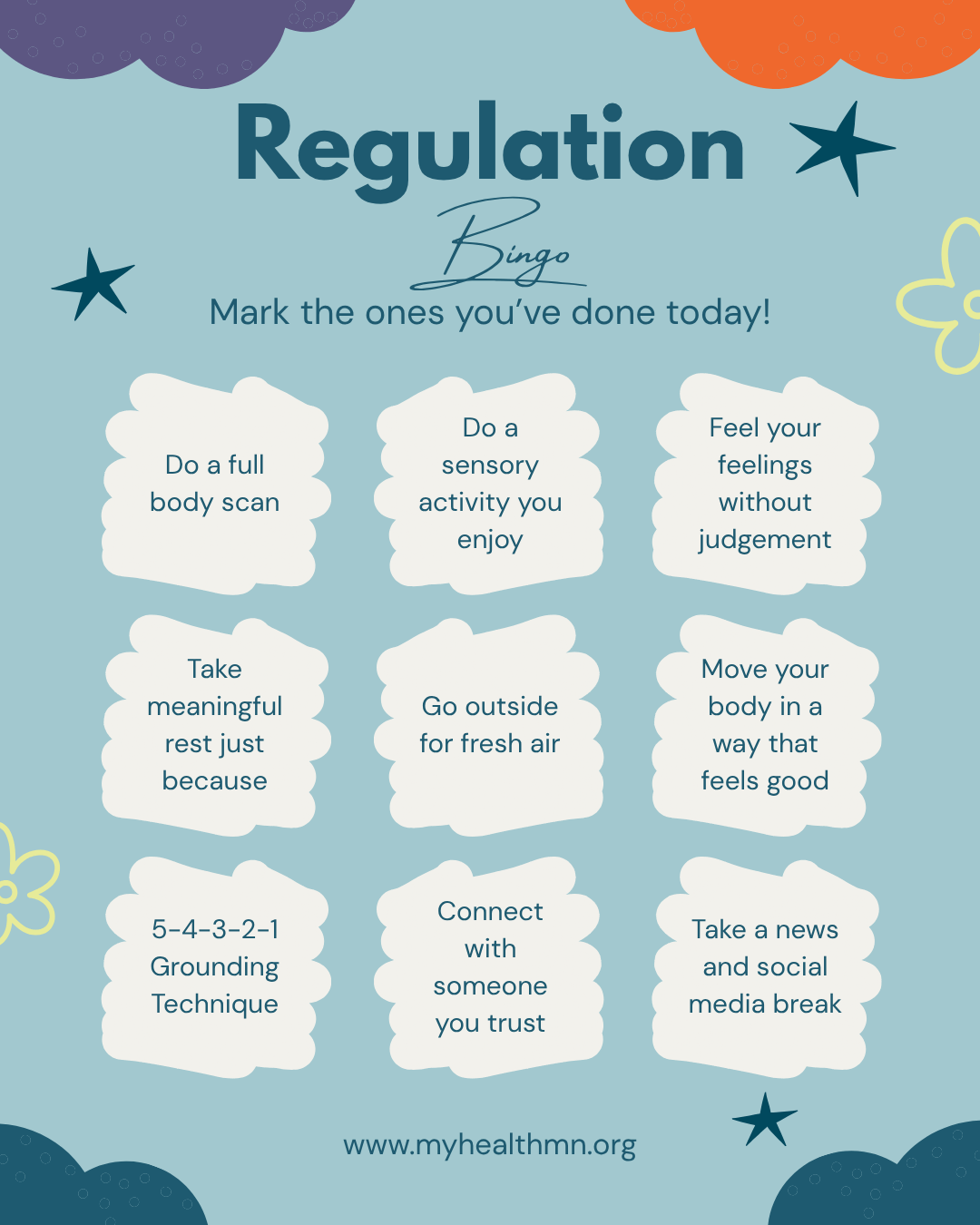
When life gets stressful, we often make choices about how to live, which can cause us to forget to take care of ourselves. To make it through these situations successfully, we all need to engage in intentional self-care. One way to start is to practice skills that help regulate your nervous system, which can reduce discomfort and help reset it. These strategies won’t make the stress disappear, but they may help you manage the stress more productively. Here are nine different skills you can use to help yourself regulate.
Doing A Full Body Scan
A body scan is a technique often used in mindfulness practice or meditation. To start, get into a comfortable, safe position where you can fully relax. Then, starting at your head or your toes, slowly mentally scan your body, noticing sensations such as pain, tension, or temperature. If you notice something uncomfortable, you can work to change it by consciously relaxing muscles, stretching, or moving in ways that make you feel better. This helps you regulate by getting you more in tune with your body and signaling to your nervous system that you can feel safe.
Do A Sensory Activity You Enjoy
One of the most accessible ways to regulate is to engage your senses, and one of the most commonly recommended coping skills is to do something you enjoy, so why not combine both? To start, think of an activity you enjoy, like knitting, listening to music, petting an animal, drawing, or something else, and do it. While you are engaging in this activity, focus on different sensations such as textures, movement, temperature, and sounds. This will help you by bringing your attention to the present, lifting your mood, and decreasing feelings of being overwhelmed.
Feel Your Feelings Without Judgment
When someone is under stress, it is easy to judge yourself for all of the emotions that come up. Maybe you feel like you have nothing to be upset about, or that others have it worse than you. Maybe you feel like your feelings indicate a personal failure. Maybe you feel guilty because you think you should be doing more. Or maybe it’s something completely different. In any case, judging your feelings is neither productive nor helpful, and one way to help stop the judgment is to name it. When you have a feeling or emotion come up, stop and take a pause. Name your feeling and how it is impacting you without trying to explain it or fix it. Then let your body do what it needs to do to let the feeling pass, maybe you need to cry or yell, and that is okay. By feeling your feelings and tending to them, you allow your brain to let them go and move on.
Take Meaningful Rest Just Because
The idea of rest is often conflated with sleep, and while sleep is a form of rest, rest encompasses much more than a nap. Rest focuses on restoring all parts of yourself, including your mental, emotional, and physical energy. To start, identify what rest your mind and body needs, which could include lying down, taking a quiet break, or permission to do nothing for a while, and then do it! Sometimes people feel like they need to earn or justify taking a rest, and while that feeling is valid, that thought process is wrong. The only thing needed to rest is the desire to restore energy; you don’t need to earn it. This rest will help regulate your nervous system and let your body switch out of survival mode during times of stress.
Go Outside For Fresh Air
People online often say others need to “touch grass” when it seems like that person is disconnected from reality. While this is not necessarily a kind or helpful suggestion, there is some truth to getting outside to feel better. Getting outside helps you regulate and lower stress hormones and is really easy to do! Simply step outside and notice how it feels. Do you feel the sun or breeze on your skin? What does it smell like? What are some other things you notice?
Move Your Body in a Way That Feels Good
Exercise is another common recommendation to reduce stress and feel better, but the word exercise often means going to the gym or doing something you don’t enjoy. This does not have to be the case; any movement, including stretching, dancing, flexing muscles while sitting, or taking a walk, can help discharge nervous energy and release built-up tension within the body. This shift in energy signals to your brain that you can relax and improves your mind-body connection.
5-4-3-2-1 Grounding Technique
The 5-4-3-2-1 grounding technique helps you feel more present in the moment by using all five of your senses. Name five things you see, four you feel, three you hear, two you smell, and one you taste. For example, I see a mug, laptop, phone, blue wall, and a pen; I feel the warmth of my jacket, the keyboard under my fingers, the support from my chair, and my feet on the floor; I hear my podcast, my laptop humming, and the sound of typing, I smell food for lunch and my cup of tea; I taste the tea as I drink it. Now I am oriented in my space, and my nervous system feels a little bit safer.
Connect With Someone You Trust
The first way that everyone learns how to regulate is through something called co-regulation. This is when a small child looks to a trusted adult to figure out how to feel and act, and by modeling the adult, the child feels better. If you are very stressed, you can co-regulate at any age. Give a trusted person a call, text, or grab coffee. If you want to talk out your feelings, go for it! It’s also ok if you just want to be with someone who helps you feel a bit safer in that moment. Not only will you feel more regulated, but you will also probably feel less alone.
Take a News and Social Media Break
A huge stressor in 2026 is the constant flow of information from the news and social media. While being informed is a good thing, too much information can send your brain into overdrive and panic. By stepping away from the news and social media, even for an hour, you can get your brain back to the present and hopefully feel a bit calmer. You can do this by putting your phone in another room, turning on do not disturb, or silencing notifications while you do something you like (maybe one of the other suggestions above?). This will help you feel less overloaded and stressed during that time and make it easier to manage more effectively later on.
These are only a few of the many ways to support your own regulation, and the most important thing is to find what works best for you. You do not need to do everything or be perfect when you are trying to regulate; even small or imperfect actions can make a big difference when you are stressed. Remember to be kind to yourself, take care of yourself, and take care of those around you. And if you need more help, feel free to give us a call at myHealth at 952-474-3251.